What Is Regulatory Compliance? A Practical Guide for Growing Organisations
By Eoghan Kenny · 4 May 2026
Regulatory compliance means more than meeting rules. Learn what it is, why it matters, common challenges, and how organisations can manage it in a practical, scalable way.
Regulatory compliance is often treated as a legal or administrative requirement. Something organisations need to "get through" to satisfy regulators, auditors, clients or investors. That view is understandable, but incomplete.
At its best, regulatory compliance is a practical operating discipline. It helps an organisation understand its obligations, manage risk, prove accountability and run with greater confidence. It creates structure around what the business has already committed to do, whether those commitments come from law, industry standards, customer contracts, internal policies or strategic decisions.
For growing organisations, this distinction is important. Compliance is no longer a concern only for large enterprises or heavily regulated sectors. Smaller and mid-sized companies are increasingly expected to demonstrate structured governance, documented controls and audit-ready evidence, especially when selling into regulated clients, processing personal data, adopting AI, or working across complex supply chains.
The challenge is that many organisations understand what they need to comply with. They struggle with how to operationalise it. That is where regulatory compliance becomes either a source of friction or a foundation for growth.
What is regulatory compliance?
Regulatory compliance is the process of ensuring that an organisation meets the laws, regulations, standards, contractual obligations and internal rules that apply to how it operates.
In practice, this can include requirements around:
- Data protection and privacy
- Information security
- Financial controls
- Health and safety
- Environmental management
- AI governance
- Operational resilience
- Sector-specific licensing or reporting
- Internal policies and procedures
- Customer or supplier assurance requirements
For example, a SaaS company may need to demonstrate GDPR readiness, prepare for ISO 27001, respond to security questionnaires from enterprise clients and document how it manages information security risks. A healthcare provider may need to manage incident reporting, training records, safeguarding policies and regulatory inspection evidence. A financial services organisation may need to meet digital operational resilience requirements and show clear oversight of third-party ICT providers. The common thread is not paperwork. It is accountability.
Regulatory compliance gives an organisation a way to show that it knows what is required, has controls in place, monitors whether those controls work, and can produce evidence when needed.
Why regulatory compliance has become harder to manage
For many organisations, compliance used to feel like a checklist. Define a few policies, prepare for an audit, keep records somewhere and respond when asked. That model no longer reflects how business works.
Regulatory expectations are expanding across multiple areas at the same time. GDPR continues to shape how organisations collect, use and protect personal data, with specific obligations around accountability, lawful processing, breach management, DPIAs and data protection by design. NIS2 has expanded cybersecurity expectations across 18 critical sectors in the EU, increasing attention on risk management, incident response and governance. DORA has applied since 17 January 2025 for financial entities and focuses on digital operational resilience, ICT risk and third-party technology providers. The EU AI Act is also being phased in, with obligations applying across different dates depending on the type of AI system and role of the organisation.
This creates a practical problem. Organisations are not dealing with one compliance requirement at a time. They are dealing with overlapping obligations, multiple stakeholders and increasing evidence demands.
A single business might now need to show:
- How it protects personal data
- How it manages cybersecurity risk
- How it reviews suppliers
- How it controls documentation
- How it records incidents
- How it manages AI-related risks
- How it responds to audits or customer due diligence
- How it proves ownership of actions and decisions
The more these requirements grow, the more important structure becomes.
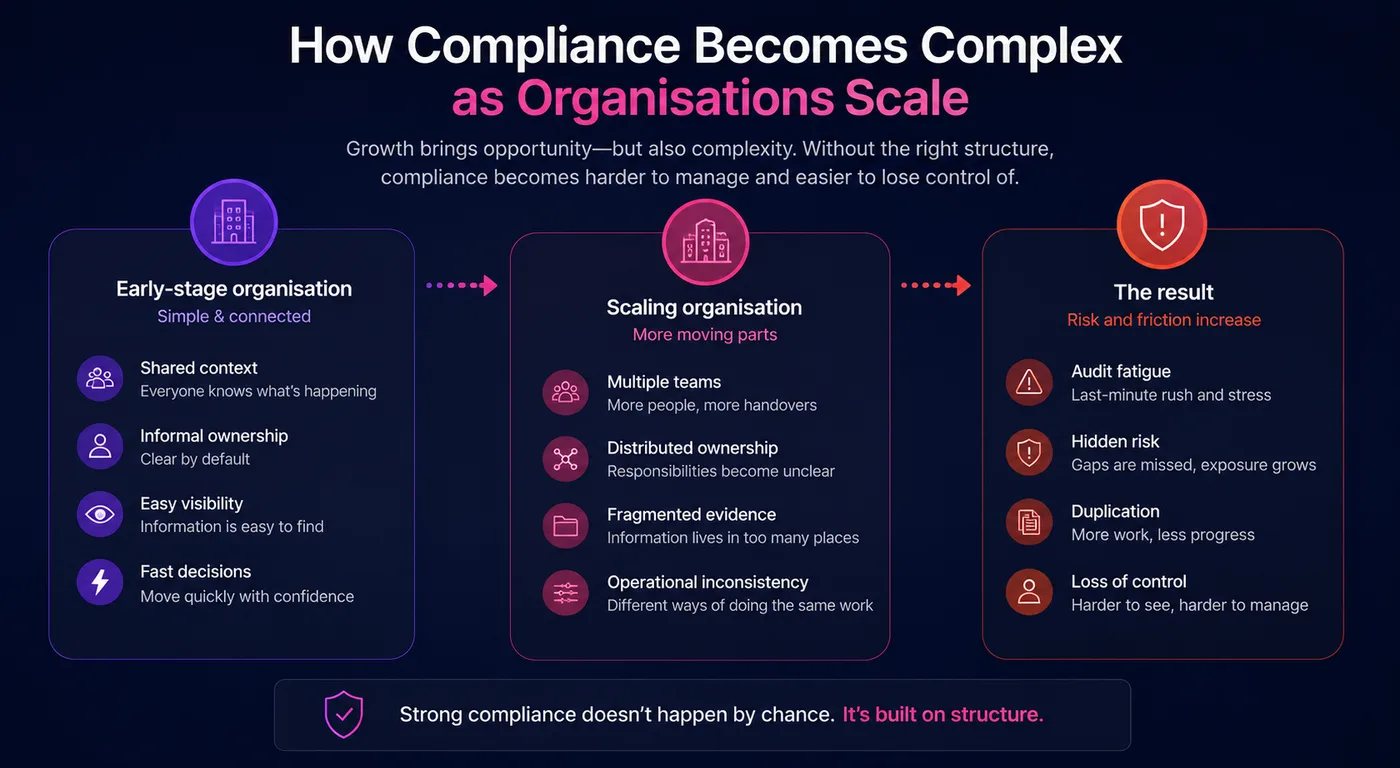 As organisations grow, compliance gets harder: ownership spreads, evidence fragments and risk becomes harder to see. Illustrative image generated with AI.
Without structure, compliance turns into repeated effort. Evidence is recreated for each audit. Documents live across folders, inboxes and spreadsheets. Risk registers exist but are not actively used. A few people become responsible for "holding it all together". This is one of the core problems 3Be identifies in the market: many teams understand their obligations, but struggle to turn them into working systems that support day-to-day operations.
Regulatory compliance is not just about avoiding penalties
Avoiding fines, sanctions and reputational damage is an important part of compliance. But organisations that view compliance only as a defensive activity often miss its wider value.
Well-managed regulatory compliance can help organisations:
1. Build trust with clients and partners
Clients increasingly want assurance that suppliers can protect data, manage risk and operate responsibly. This is especially true in SaaS, professional services, healthcare, finance, infrastructure and public-facing sectors.
In many cases, compliance maturity becomes part of the sales process. A company may not be directly regulated, but still needs to demonstrate assurance to larger clients or regulated customers.
For example, a B2B software provider selling into financial services may be asked for evidence of security controls, GDPR processes, risk management practices and incident response procedures before a contract is signed. The ability to respond quickly and confidently can influence procurement outcomes.
2. Improve operational clarity
Compliance requires organisations to define how work should happen. That includes ownership, approvals, reviews, escalation paths, records and controls. Done badly, this creates bureaucracy. Done well, it creates clarity.
A simple example is document control. Many teams hear "document control" and imagine a heavy, formal system. In practice, the foundation can be straightforward: know which version is current, who approved it, where it is stored and when it needs review.
The same applies to management review, internal audit or corrective action. These are often seen as compliance rituals, but they are simply structured ways to ask: Are we doing what we said we would do? Is it working? What needs to improve?
This reflects a broader 3Be principle: compliance should improve how the business operates, not distract from it.
3. Reduce repeated manual effort
Regulatory compliance becomes expensive when evidence is recreated every time someone asks for it.
That might happen during:
- Customer due diligence
- Certification audits
- Regulator requests
- Internal reviews
- Security assessments
- Board reporting
- Tender submissions
If evidence lives in scattered systems, every request becomes a search exercise. Teams lose time finding the latest policy, checking whether actions were closed, confirming who reviewed a risk or rebuilding an audit trail from emails.
A stronger approach is to create live evidence as work happens. In the 3Be founders' discussion, one example used was software development: when records are generated as an output of the normal workflow, teams reduce manual effort and avoid relying on people to write records from memory later. That principle applies far beyond software development. The best compliance evidence is often produced naturally by a well-structured process.
4. Support better decision-making
Compliance data can help leaders see where risk sits, which actions are overdue, which suppliers need review, which documents are due for approval and where recurring issues are appearing.
This matters because regulatory compliance is not only about proving what happened in the past. It is also about making better decisions now.
For example, a company that tracks incidents, corrective actions and supplier risks in one place can identify patterns earlier. If repeated incidents are linked to one process, supplier or department, leadership can act before the issue becomes larger.
In that sense, compliance becomes a management tool.
The difference between regulatory compliance, standards and internal policies
One reason compliance becomes confusing is that different types of obligations are often grouped together. They are connected, but not identical.
Regulations
Regulations are legal requirements. They may apply because of the organisation's location, sector, customers, products, services or data processing activities.
Examples include GDPR, DORA, NIS2 and the EU AI Act.
Standards
Standards are structured frameworks that help organisations manage specific areas of governance, quality, security or operations. Some are certifiable, such as ISO 9001 or ISO 27001. Others provide guidance or best practice.
Standards are often useful because they translate broad expectations into structured requirements. Organisations can use standards as guidance to design better processes even before deciding whether certification is necessary.
Internal policies
Internal policies are rules the organisation sets for itself. They define how the business chooses to operate. Examples include:
- Information security policy
- Data retention policy
- Supplier management procedure
- Incident response process
- AI usage policy
- Health and safety procedure
- Document approval process
A mature compliance system connects these layers. Regulations define what must be achieved. Standards help structure the approach. Policies explain how the organisation applies that structure in practice.
A practical example: regulatory compliance in a growing SaaS business
Consider a SaaS company with 70 employees selling into enterprise clients. In its early days, compliance was informal. Policies were stored in shared folders. Security reviews were handled manually. Supplier checks happened when needed. Risk was discussed in meetings, but not consistently recorded.
As the company grows, the pressure changes. Enterprise clients start asking for ISO 27001 readiness. Procurement teams ask for GDPR documentation and information security evidence. Investors ask about operational maturity. A new product feature introduces AI functionality, creating governance questions. A prospective client asks whether the company has a formal incident response process.
The company now has two choices. It can respond reactively, creating documents and evidence each time a request appears. That may work for a while, but it increases effort and creates inconsistency.
A stronger approach is to map what obligations apply, define core processes, assign ownership, create reusable evidence and build a repeatable compliance rhythm.
That might include:
- A central policy register
- Defined approval and review workflows
- A supplier risk register
- Incident reporting and corrective action processes
- Data protection records
- Security risk assessments
- A recurring management review cadence
- Clear audit trails for decisions and actions
This does not need to begin as an enterprise-level GRC programme. The goal is to create enough structure that the business can scale without rebuilding its compliance foundations every time a new customer, framework or regulation appears.
Common regulatory compliance mistakes
Many organisations do not fail at compliance because they lack effort, but because the effort is poorly structured.
Mistake 1: Treating compliance as a separate project
When compliance is treated as a parallel world, teams create documents and records to satisfy audits rather than improve how work happens. The result is duplication, low engagement and systems that are hard to maintain.
This is one of the biggest mistakes organisations make: seeing compliance as separate from the business instead of part of how the business runs.
Mistake 2: Starting with too much
Teams often try to cover every policy, control, framework and risk at once. This creates overwhelm before the system has a foundation.
A better starting point is to identify what matters most:
- Which regulations apply?
- Which clients or stakeholders require evidence?
- Which processes create the most risk?
- Which documents are critical?
- Which actions need clear ownership?
- Which evidence is repeatedly requested?
Compliance becomes easier to manage when organisations start with the core operating model and build from there.
Mistake 3: Over-documenting
Documentation is necessary, but excessive documentation creates its own risk. If documents are too detailed, too rigid or disconnected from real work, people stop using them.
A useful policy or procedure should help people understand what needs to happen, who owns it and how evidence is recorded. It should be specific enough to guide action, but flexible enough to fit the way the organisation actually works.
Mistake 4: Relying on individuals instead of structure
In many growing organisations, compliance depends on a small number of people who know where everything is, what has been done and what still needs attention. That creates hidden risk. If those people leave, become overloaded or miss something, the system weakens.
Good compliance creates visible ownership. Actions, reviews, risks, documents and decisions should not depend on memory.
Mistake 5: Preparing for audits instead of running the business well
Audit preparation becomes stressful when evidence is collected only at the end. A stronger system creates evidence continuously. When work is structured properly, audit readiness becomes a by-product of how the business operates.
This is central to 3Be's brand narrative: audits become easier when the business is already running in a structured way.
How to build a stronger regulatory compliance foundation
Regulatory compliance can be approached in a practical sequence.
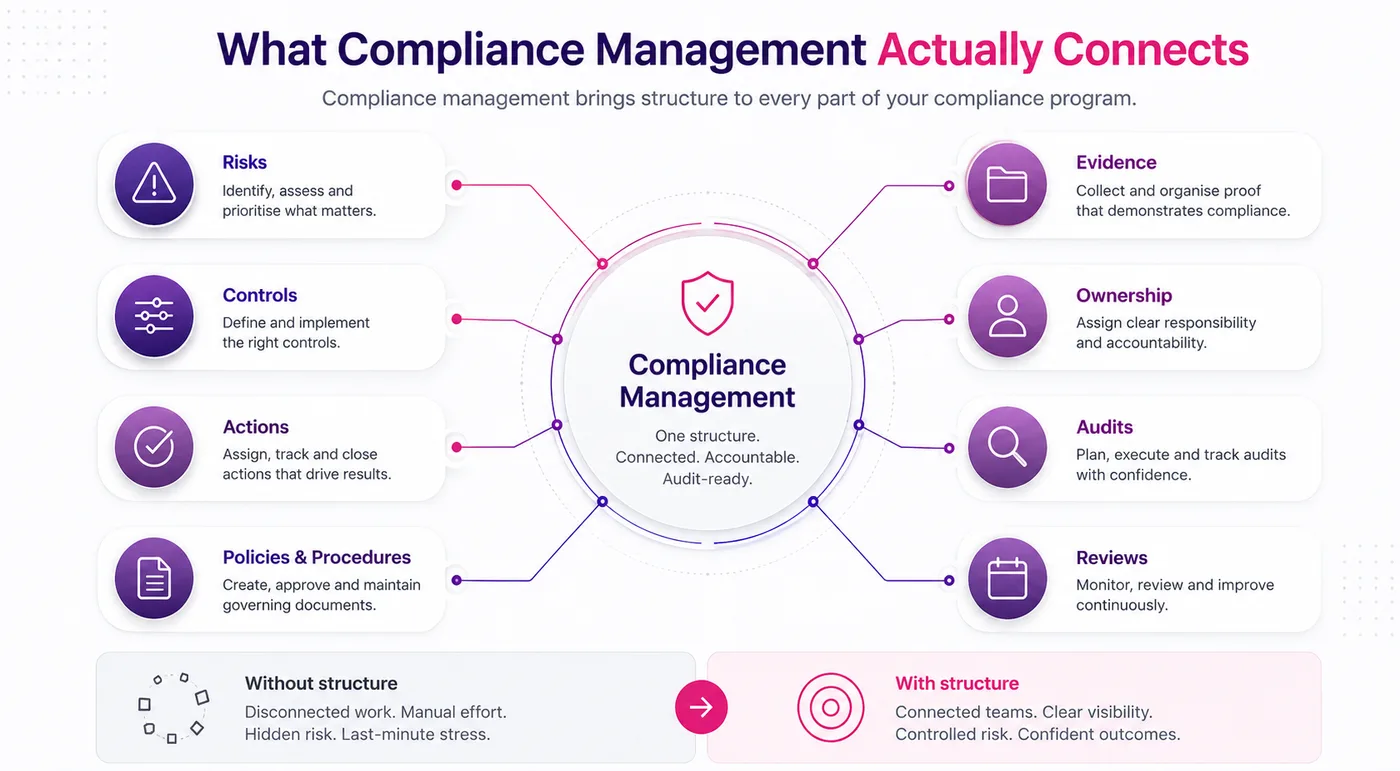 Compliance management brings risks, controls, actions, policies, evidence, ownership, audits and reviews into one connected structure. Illustrative image generated with AI.
1. Map your obligations
Start by identifying the laws, regulations, standards, contracts and internal commitments that apply to the organisation.
This should include:
- Legal and regulatory obligations
- Customer requirements
- Certification requirements
- Sector-specific standards
- Internal policies
- Supplier or partner obligations
The purpose is not to create a perfect compliance universe on day one, but to understand what the organisation needs to manage.
2. Define ownership
Every meaningful compliance activity needs an owner.
That includes:
- Policy ownership
- Risk ownership
- Control ownership
- Action ownership
- Incident ownership
- Supplier review ownership
- Evidence ownership
Ownership should be visible and practical. If everyone is responsible, no one is accountable.
3. Connect compliance to business processes
The most effective compliance systems start with how the business already works.
For example:
- How are suppliers onboarded?
- How are customer complaints managed?
- How are incidents reported?
- How are documents approved?
- How are software changes reviewed?
- How are employees trained?
- How are risks escalated?
- How are decisions recorded?
Once these processes are understood, compliance requirements can be embedded into them.
4. Keep evidence live
Evidence should be generated as part of the work, not reconstructed later.
Examples include:
- Approved policies with version history
- Completed risk reviews
- Closed corrective actions
- Supplier assessments
- Training records
- Incident reports
- Meeting minutes
- Audit findings
- Document approvals
Live evidence reduces last-minute audit preparation and increases confidence when clients or regulators ask for proof.
5. Review and improve
Compliance is not a one-time exercise. Regulations change. Businesses change. Products change. Teams change. A practical review rhythm helps organisations stay aligned. That might include quarterly risk reviews, monthly action reviews, annual policy reviews or management reviews split across the year.
The format matters less than the function. The goal is to regularly ask what has changed, what is working, what needs attention and what evidence exists.
How regulatory compliance software supports this work
Regulatory compliance software can help organisations move from scattered, manual processes into a structured operating model. The value is not simply storing documents. The value is connecting work.
3Be's Wizard platform is designed as a flexible, modular environment for building and running Governance, Risk and Compliance programmes. It brings together tasks, documents, registers, risks, forms, workflows and dashboards in one place, so each user can see what is relevant to them and what needs attention.
For organisations managing regulatory compliance, this kind of structure can help with:
- Centralising policies and procedures
- Tracking actions and responsibilities
- Managing risks and reviews
- Capturing structured data in registers
- Automating reminders and workflows
- Maintaining audit trails
- Preparing evidence for audits, tenders or client due diligence
- Scaling compliance across teams, departments or entities
Wizard is also designed to support different organisational sizes and sectors, from startups preparing for ISO or GDPR readiness to mid-market organisations formalising governance and enterprise groups managing oversight across multiple entities.
The aim is not to make compliance feel like a separate system. The aim is to help organisations turn regulatory requirements into practical working systems.
Regulatory compliance checklist for growing organisations
A simple starting checklist can help leadership teams assess maturity:
- Do we know which regulations, standards and customer requirements apply to us?
- Do we have clear owners for compliance activities?
- Are our key policies current, approved and easy to find?
- Do we know where our main risks sit?
- Are actions tracked to completion?
- Can we produce evidence without searching across multiple systems?
- Are supplier and third-party risks reviewed consistently?
- Do teams understand how compliance affects their day-to-day work?
- Are audits treated as a recurring discipline rather than a last-minute event?
- Do we review and improve the system regularly?
If the answer to several of these questions is unclear, the issue may not be the regulation itself. It may be the operating structure around it.
The real goal: compliance that helps the business run better
Regulatory compliance is often introduced through pressure: A client asks for evidence; A regulation changes; An audit is scheduled; A new product creates new risk; A board wants stronger oversight. Those triggers are real. But the organisations that get the most value from compliance use that pressure to build better systems.
The goal is not more paperwork. It is better visibility, clearer ownership, stronger evidence and more confident decision-making.
Regulatory compliance works best when it is embedded into how the business runs. That is when it becomes more than a requirement. It becomes part of how the organisation builds trust, reduces risk and scales responsibly.
How 3Be can help
3Be helps organisations operationalise governance, risk and compliance through Wizard, a compliance operating system designed to turn frameworks into practical working systems.
Wizard helps teams connect actions, documents, risks, registers and workflows, reducing manual effort and making compliance easier to manage over time.
If your organisation is trying to move from scattered evidence and manual processes to a more structured approach, you can learn more or book a demo with our team.
FAQ
What does regulatory compliance mean?
Regulatory compliance means ensuring that an organisation follows the laws, regulations, standards, contractual obligations and internal rules that apply to its operations.
Why is regulatory compliance important?
It helps organisations reduce risk, demonstrate accountability, build trust with clients and regulators, and operate with greater clarity.
What is an example of regulatory compliance?
Examples include meeting GDPR data protection obligations, preparing for ISO 27001, managing cybersecurity requirements under NIS2, or maintaining operational resilience under DORA.
Who is responsible for regulatory compliance?
Responsibility depends on the organisation, but compliance usually involves leadership, legal, risk, operations, IT, security and department owners. Strong systems make ownership visible.
How can software help with regulatory compliance?
Compliance software helps centralise documents, track actions, manage risks, automate workflows, maintain audit trails and make evidence easier to access when needed.
Get started
How mature is your compliance today?
Our team built a free, practical health check so you can see your maturity across governance, risk, evidence, ownership and operations, which one is holding you back, and what to do about it first. Start the Health Check.